Have feed back, suggestions, or questions? CLICK HERE to Send us a Message.
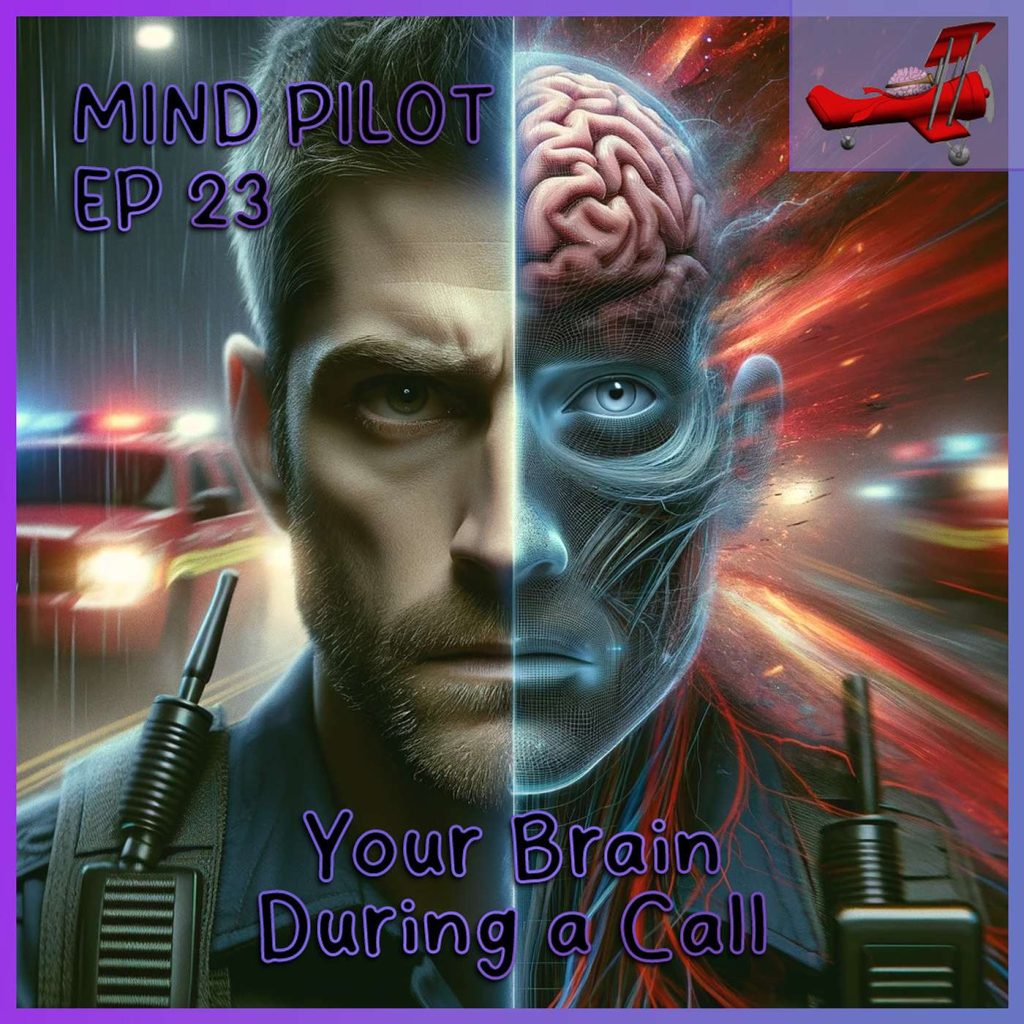
Mind Pilot Episode 23
Dive into the adrenaline-fueled world of first responders with Dr. Jana Price-Sharps in this insightful episode of Mind Pilot. Joined by Dr. Matthew Sharps, the discussion unveils the physiological transformations during high-stress situations, such as the redistribution of blood flow affecting the prefrontal cortex, leading to impaired cognitive functions. Learn about the life-and-death consequences of tunnel vision and auditory exclusion, crucial challenges faced by professionals in the heat of the moment. For anyone fascinated by the mind-body connection or those in high-stakes professions, this episode is an eye-opening exploration of human survival mechanisms. Don't forget to hit subscribe for more engaging content like this.
Topics Covered:
- ADRENALINE'S PHYSICAL IMPACT: Exploring how high adrenaline levels during 'hot calls' redistribute blood flow and resources away from the prefrontal cortex, affecting cognitive function and decision-making.
- TUNNEL VISION DURING CRISIS: Discussing the psychological shift to tunnel vision in high-stress scenarios, its causes, and its potentially dangerous implications for first responders.
- AUDITORY EXCLUSION UNDER STRESS: Examining the phenomenon of auditory exclusion, where high-stress situations can significantly diminish one's ability to perceive sound accurately.
- EXECUTIVE FUNCTION AND IMPULSE CONTROL: Analyzing how extreme stress impacts executive functions, particularly impulse control, and the resulting consequences for professional conduct and safety.
Episode Transcript
Welcome to Mindpilot. This is Dr. Jana Price-Sharps. Thank you for listening to us today. Don't forget to subscribe. So we have a guest today, and you have heard him before. I am with Dr. Matthew Sharps, and we're going to talk a little bit more about what happens to you physically when you're on a hot call. And the call could be a number of different kinds of calls, but let's say it's a call that you are getting adrenalized, maybe there's some trauma, um, and you're beginning to feel the results of high levels of adrenaline. What is going on with your body? What is going on with your brain? So, Dr. Sharps, I know there's a number of different things that happen with the body and the brain when that begins. Can you just generally give us some information about the changes in blood flow, for instance?
SpeakerYeah, sure. The brain is an incredible energy hog. It weighs about 2% of your body weight, but depending who you read, it's using about a fifth to a quarter of your overall blood-borne resources. Now, when you go into the fight or flight response, you need more blood flow to your muscles for a whole variety of reasons, obviously to strengthen them, give you better endurance, and so on. That blood's got to come out of someplace. Now the problem with this is that the brain has a variety of functions that you really can't be without. Many of the lower brain centers are concerned with basic survival, upper brain centers with things like vision, and you really don't want to go blind in the middle of a fight, for example, with figuring out where things are, what things are, the orientation of your body, et cetera. So a lot of the brain, you really can't uh take that bloodborne resource level down very much. So where you take a lot of it out, and this is a little oversimplified, but it's pretty close, a lot of it comes out of the prefrontal cortex, and that's the part of the brain that basically makes you smart. That's where your intellectual functions are. So a variety of behavioral things have been identified in research that uh essentially come out of that diminished blood-borne resource availability to the pre-frontal cortex. That's the very front of the upper part of the brain.
Speaker 1I see. So you mentioned vision, and I know that one of the things that often happens in high stress situations is tunnel vision. What's happening with the brain when they have tunnel vision?
SpeakerAaron Ross Powell Yeah, tunnel vision is less about uh vision per se than it is about attentional focus. What people tend to do is focus on what's directly out front rather than what goes is going on either uh to either side or in the periphery. All right. So we have many, many cases where people have uh tragically focused on what they perceive to be important in a situation, and then, for example, been shot by an unseen assailant off to the side, something of that nature. Tunnel vision is one of the most uh typical phenomena, really, of a very high stress situation. A number of researchers have addressed this both in the field and in laboratory situations.
Speaker 1Aaron Ross Powell So that could be very dangerous for a first responder.
SpeakerAaron Ross Powell Oh, absolutely. Absolutely. Uh for example, if you think about a fire uh firefighters where they're focused, desperately focused on the situation right in front of them, if they miss what's going on to the sides where the fire may be sweeping around, this could be hugely uh hazardous, very, very life-threatening. The same is true with uh police officers. If you're dealing with a tactical situation where there's more than one assailant, if you have inadvertently identified the assailant's right on front as the sole threat, um you could wind up uh with a peripheral threat uh that could be could be literally lethal.
Speaker 1Wow, that's an important thing to understand. I think that there is also uh some other things that happen when you're under high stress. One of them might be changes in hearing.
SpeakerYes. Um auditory exclusion is what it's called. That's very common. The brain in the human puts a tremendous priority on vision. It's our most precise sense. So we do seem to see a lot of individuals where sound is significantly diminished. In fact, that's one of the very most common things that happens under stress. You're not going to hear sounds as loudly as they really are. They have to be careful with that, because much more rarely sounds seem louder than they are. So it's it's a it's kind of a two-edged sword. But typically, I've seen cases, for example, in which gunfire has not been heard by experienced police officers simply because they were under very high level of stress. The neurology has not been worked out very well, but it's a very real phenomenon.
Speaker 1So you mentioned that there's a change in blood-borne resources, and a lot of that's coming out of the prefrontal cortex. So does that begin to, we call it in our field the executive functioning, does this begin to impact impulse control when somebody gets very stressed?
SpeakerAaron Ross Powell, yes, absolutely. What you'll see is tunnel vision. There's a whole variety of things you'll see, but impulse control is very critical. Under stress, people may blurt out inappropriate comments. If the press hears that from law enforcement, for example, or from fire personnel, that can be a huge problem. People may blurt things out. Um a joke may occur to you under these situations that isn't particularly funny, but you have this tremendous impulse to tell it, and then later on you're going, my God, that wasn't even funny. Why did I do that? So your ability to monitor a lot of your own behavior, your impulse is diminished, and so we see here some significant failure of impulse control. There's a lot of these things that happen to us that make some sense from the very ancient world. If the heart rate goes up, for example, into the 170s, we'll sometimes see partial paralysis. Okay, a person suddenly can't move. Or we may see um urination or defecation, which is not good for your command presence if you're wearing khakis, okay? Now you wonder why the hell could that possibly happen? Well, think about the ancient world. The partial paralysis thing, possums have been pulling that trick for millions of years. Unless you're a hyena or a vulture or something, you can't eat dead things, and so if you're not moving, the saber-toothed tiger may leave you alone. If you're going to, you know, for example, urinate or defecate, um the fact of the matter is that if you're dealing with violent gang members or something, that's not going to help you. But if you were dealing with a saber-toothed tiger with a massively greater sense of smell, it's going to go from rar to ew in a few seconds, and suddenly you don't get eaten. So a lot of this stuff had utility in the ancient world. That's why it's there. That's why we think, I should say. A lot of stuff is there in the brain. But at the end of the day, uh in the modern world, these things can be an incredibly hazardous to your career or or or to your personal survival.
Speaker 1So for instance, somebody may say something to a supervisor because they have a lot of adrenaline in the system, they're not thinking really very clearly. And now, you know, they're in a lot of trouble because they impulsively said something that maybe it been taken root and or no, exactly so.
SpeakerUm this is a little uh a little oversimplified, but I think it works. I mean, if if you were in a fight with something like a saber-toothed tiger or a cave bear, a certain loss of impulse control isn't a bad idea. Do something unexpected, do something a little crazy that's going to drive the animal away. But if your brain is confusing a meeting with your superiors with a hunt in the ancient world, yeah, you're going to bit get in very, very serious trouble there. Okay, the lack of impulse control under high stress, the lack of executive monitoring that you just mentioned, these things can can uh the tactical uh dangers are obvious, but the danger to your career, to your professional advancement, to your standing within your professional community is very, very, very strong.
Speaker 1So I'm a little confused. When we're talking about impulse control problems, why are they able to do their job so effectively, even though they're having that diminished activity in the prefrontal cortex?
SpeakerAaron Ross Powell Well, there's a variety of possibilities there that would depend on a case-by-case basis. In general, though, for example, you might have a person who is so practiced or so good at their job that they simply overcome that, or a person whose job is such that impulse control in that sense isn't that critical to them. But I think one thing that may come in very, very strongly is that if you're dealing with motor skills, okay, with your tactical skills, for example, in vehicle or weapon handling, in other areas of first response, in dealing with the very very complex control systems that are involved in modern firefighting, this stuff has been automatized. A lot of it is in motor programs, which are now largely resident in to a great degree in lower brain centers that are not going to be subject to that same loss of blood flow resources you see in the prefrontal cortex. So these are several possible reasons, but it would differ depending on the professional situation, the uh the environment in which this is being the environment in which the professional skills are being deployed, a variety of other factors.
Speaker 1Aaron Ross Powell So that's why training is so very, very important.
SpeakerAaron Powell Yes, yes. Training is critical. Training in general, and this is a huge topic, but training in general should be as realistic as possible and as frequent as possible. It's basically the bathing effect, okay? You can't have one bath in the late spring of 1999 and still be clean. You kind of have to keep doing it. The same is true of training.
Speaker 1Aaron Ross Powell That makes a lot of sense. I know that when people get stressed, they tend to perseverate. Can you talk a little bit about how that might affect first responders?
SpeakerAaron Powell Yeah, that's hugely important. Yeah, perseveration is critically important. What this is, is the essentially mindless repetition of behavior, which you'll see at very high levels of arousal, because the prefrontal cortex, which tends to prevent that kind of repetition in a mindless manner, is simply not not on the job. So you might keep doing the same thing over and over again, even if it didn't make any sense. And if you couple this with tunnel vision, you can imagine, for example, a situation in which you have to go through a barrier that you cannot get through, still doing the same thing again and again with tools or with uh weapons, et cetera, uh which simply aren't working for you as your adversary's or your adversarial situation, the case of a fire, changes the way it's operating. So in a way, tunnel vision and preserveration can come together to be extremely threatening. It's very important to recognize that a high level of cognitive flexibility is necessary in in many uh first response situations. And that's one of the things that your brain is more or less reducing in you, the ability to have this flexibility that forces you away from tunnel vision and away from perseveration. It's one of the things that is diminished and once again, uh very you know strong, solid training that's based in the realities of what you're dealing with, that's repeated to the degree that makes sense is one of your better defenses against that, against those factors.
Speaker 1So that would explain why I've heard guys and gals on the radio that are either newer to a department or they're much more senior, and there's such a difference generally in how they're talking on the radio, especially when it's a high-intensity situation. I have s I've heard uh very senior guys just talking like they're having a conversation. We need this en route, we need that in route, this is gonna happen. And it could be a very intense situation that they're responding to, and yet you get a younger man who or younger woman who is almost screaming into the radio, so that long-term effects of training, again, is going to keep them from uh repeating things or not being able to talk coherently.
SpeakerAaron Ross Powell Yes, that makes sense. Training and experience combine there, assuming the individual, the operator and the first responder, has learned from their experience. If you think about language and speech, most of it is about ordering things correctly. Okay. You want to give a linear chain of logic operating with as few redundancies as possible. Well, that's going to be easier as you've developed the relevant brain traces through experience and, of course, through training.
Speaker 1Aaron Ross Powell That makes sense. How does all of this impact memory?
SpeakerAaron Ross Powell Yeah, we see uh frequently, it's about midway down the list of things that can go wrong when you're under extreme stress. Uh memory loss. People often do not remember the things that happened when they were under extreme stress, and this can assume very special significance. For example, in court, when something was done or not done, and the individual simply doesn't remember having done this. Are they lying or did they simply have the nervous system do what it does, which is remove the memory? More rarely, but it's still quite common, is reconfiguration of memory. The memory actually changes. And it's not just the event that can do that or the stress. We had situations, for example, an experimental situation, in which our respondents weren't under any stress at all. But when we showed them a crime situation, asked them questions about it. The first time we asked them, they gave us significantly more correct responses than mistakes. By the third time, it was the other way around. They were actually giving us slightly more mistakes than correct responses. What had happened was the mistakes they'd made in previous iterations of the memory had now become part of the memory. And this kind of thing was known by uh as far back as 1932, but especially this was uh uh illuminated by the work of Elizabeth Loftus about forty, forty-five years ago, in which just the language used can change the memory of an individual. When you say how fast was a car going when it bumped into another car, if the car is going about fifteen miles an hour, people say fifteen miles an hour. If you say how fast was it going when it crashed into the other car, not only can people start to increase the perceived speed of the vehicle, but they may start to see other types of damage, broken glass and so forth that wasn't there at all. So memory changes, as it was demonstrated in 1932, memory changes in three directions. Memories get shorter, they become more about the core of whatever happened, and they'll change in your direction of personal belief. And although the data the data is equivocal here in summer to some degree, but in general, uh you see these factors exacerbated under stress, and you'll see this quite frequently in criminal investigation and in court.
Speaker 1Is that the reason when you ask somebody about a divorce, their story is completely different than the other person?
SpeakerAaron Ross Powell It is kind of interesting. When you ask a group of people, um, you know, have you how many of you have been divorced or have you ever broken up with anybody? And you get sort of responses, well-adjusted people go, mm-hmm, yes. Some people ask, yes, and a few people scream, yes, what about it? Okay. Well then you say, did the stor your story and their story, do they bear any resemblance to each other? And the answer, depending on level of rage, is usually no, no, or no. So, um no, the people we tend to assume that our memory is relatively intact. An example I always use, suppose you had a very, very good jigsaw puzzle that came in a frame, okay? If you turn it upside down and shook it once, well, a few pieces fall out. Let's say it's a picture of a barnyard or something. Well, a few pieces have fallen out, but you've still basically got a barnyard. Okay? That's pe everybody knows they forget, but they assume the memory is basically intact. And what really, excuse me, now what eighty of actually ninety years of research have shown us is that that simply is not correct.
Speaker 1Aaron Ross Powell Wow. That has major implications for every first responder.
SpeakerTrevor Burrus, Jr.: Absolutely, because again, I don't I do want to reiterate this. The memory loss and then memory reconfiguration. Memory loss is more common, but they are fairly common uh reported situations under uh high levels of stress.
Speaker 1Interesting. Well, we're going to have a number of segments on memory and the effects of adrenaline on the system and how it impacts first responders. So this is just one in many, but thank you for joining us today, Dr. Sharps. We appreciate your time.
SpeakerAaron Powell Well, thank you. I appreciate being here.
Speaker 1And this is Mindpilot. I am This is Dr. Jana Price-Sharps. Please subscribe. You have the right to have a wonderful day and a wonderful life. So I hope you keep working on yourself and feeling better. Take care.