Have feed back, suggestions, or questions? CLICK HERE to Send us a Message.
Mind Pilot EP 68
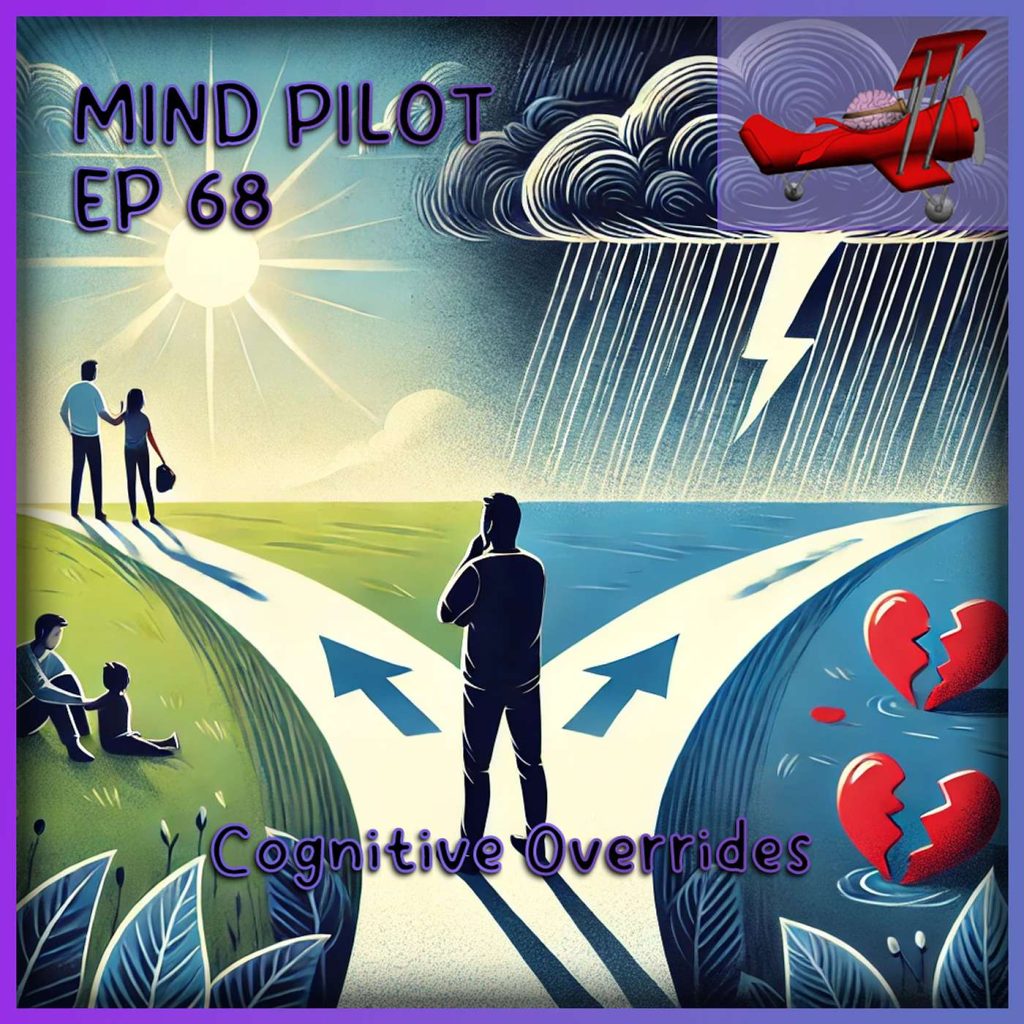
On this episode of Mind Pilot, Dr. Jana Price-Sharps introduces the concept of cognitive overrides and explains how they can help you navigate life's emotional challenges. By leveraging logical thinking over impulsive reactions, you can make better decisions in both personal and professional situations. Discover how to apply these techniques to avoid common mistakes and maintain congruence with your morals and values.
Topics Covered:
Definition: Explanation of cognitive overrides and their importance
Application: How to use cognitive overrides in everyday situations
Examples: Real-life scenarios demonstrating the effectiveness of cognitive overrides
Benefits: Advantages of making decisions based on logic rather than emotion
Episode Transcript
Good day. This is Dr. Jana Price-Sharps from Mindpilot. Thank you for joining us today. Today we're going to talk about what I call cognitive overrides. I don't know if anybody else uses that term, but I use it. And here's what this means. Let's say, hmm, that you don't feel like being nice today. Maybe you're just cranky and you woke up on the wrong side of the bed and your significant other comes in and says something and you just feel like snapping at them. And you can do that, but of course, it's going to make your day worse. It's going to start a big argument, usually or often. And so what do you do instead? And so I use cognitive overrides in my life. And what that means is basically, well, for one, if I'm mad, I tell myself to be quiet until I can say something nice. I call it until I can play in the sandbox nicely. I don't go in the sandbox, you know, but I might uh just say something logical and end the conversation. You know, something like, you know what, I'm gonna go take a shower. Good morning. I hope you're doing well this morning, or something like that. And then I get out of the room so that I can kind of walk myself through the process of what I need to say. But the other use of cognitive overrides is a lot of times people are in predicaments that they know the answer, but they don't want to do it. So maybe there is a coworker you're working with, and you think, wow, that person's so great and it's so wonderful, but I'm married and I'm in this long-term relationship or whatever. And but you start fantasizing. And I often will ask people when they bring this to me, uh, when I see them clinically, they'll say, you know, but this person's so great, and it's, you know, and I'll say, okay, what would you, who's your best friend? And so maybe they'll say, Sid's my best friend. Okay. So if Sid came to you and told you what you just told me, what would you tell Sid to do? And invariably the person will say, Well, I tell Sid not to do it, because it's just going to cause him problems, and his wife is going to find out, and then it's going to be bad, and he may end up divorced, and he's got two kids. I'm like, all right. So we often know what we should do, what would be best for us, but we don't want to do it because our emotions are there and they get to running pretty heavily, and we go with the emotions. And unfortunately, the emotions are not always going to direct us in a way that we need to go. So I want you to think about do you have any circumstances in your life where your emotions are telling you one thing and your prefrontal cortex, your logical center, is saying, don't you do that. That's a really bad idea. Remember the Yerkes-Dotson curve that we talk about all the time, that fight or flight curve. And the farther you get over on the right-hand side of that curve, which is where you're really heated up, you have a lot of adrenaline, you have a lot of cortisol in your system. And when that happens, we all have a diminished ability to think. And that is when our emotions take over and get us into trouble. Or it's one of the one of the times that that will happen. So really think about taking that step back and maybe even giving yourself a little time to think about it and then asking yourself that question. What would I tell my best friend to do? And then listening to yourself. You can't just answer that and then not do it. Answer that and then do what you tell your best friend to do. Because that's taking the emotion out of it. And you're you're going to end up in much better circumstances if you're listening to the logic, especially when you're about ready to make a decision that's going to cause you problems. And that could be anything. That could be having two more shots of whiskey at the bar. It could be, I don't know, meeting up with that pretty person or handsome person at work and not telling your spouse about it. It could be telling your supervisor what you actually think of them. You know, it could be a whole bunch of different things. But really take that step back and ask yourself, is this a good idea? It might be fun or it might feel good in the moment, but is it a good idea? And usually when people take that step back, they can make very rational decisions and it keeps you from having a lot of bad things happen to you. I don't care whether it's a divorce or a DUI or you're getting fired from your job. It that rational behavior in very emotionally volatile situations can really prevent a lot of heartache in lives. I uh have had guys and gals as well come in over the years and they're really thinking about that affair. So here's one of the things that I do. I'll say, okay, say that you do have that affair. Say that tomorrow night you actually meet this person. Maybe you go to a hotel, maybe you have sex with this person. Then what would you do? Well, I'd go home. Okay. And so who's at home? Well, my spouse is. Oh, okay. And what does your spouse usually do when you get home? And by this time they're looking a little uncomfortable, and they're saying, well, he or she usually comes up and says, you know, how was your day? Or I'm glad you're home, or gives me a kiss, or says something to me. You know, okay. So let's say your spouse comes up and gives you a hug. How are you gonna feel after you just slept with another person? How are you gonna feel about that? And most of the time people go, Oh, I'm gonna feel really kind of miserable. Okay, so what often will happen is when people start feeling guilty, they'll push the other person away. They'll say something like, you know, I gotta just take a shower, leave me alone, or something like that because they feel guilty. And so now they start this process where they're kind of antagonizing that relationship so they can justify what they're doing. And then the more they do that, the more they antagonize that other person, then that relationship becomes worse and worse. And then when they're with the person they're having an affair with, they can talk trash on their spouse. Well, she nags me about this, and she's always complaining about this, or he's always complaining about this, or whatever. And so what ends up happening is they get farther and farther away from the person that they're in that long-term relationship with, and they get closer and closer to the person they're having an affair with. So there's a few things that you need to ask yourself about this. For instance, what happens when you have a holiday and you have that day off? Who are you gonna spend it with? You gonna spend it with your spouse or your significant other, or are you gonna spend it with the person you're having an affair with? What about your birthday? Who does you who are you gonna spend it with? Are you gonna spend it with your spouse or significant other? Or are you gonna spend it with the person you're having an affair with? Are you willing to leave the person that you're having a long-term relationship with or who's your spouse? Are you willing to walk away from that relationship, or do you just want them both until it blows up into your face? Because almost always they find out at some point. And now they find out you've had a two-year affair, the war is on. Okay. So you need to be asking yourselves those things. Are you gonna be able to go home and go to bed with your spouse or significant other after you've had sex with somebody else? Maybe you can. But if you're gonna feel guilty, is that a good decision for you? Think about where your moral compass is. And that's up to you. I'm not preaching morals, but what I am saying is the more congruent you are with your morals, the happier you're gonna be. If that's something that you don't agree with, then don't do it. And figure out how to fix it at home. Figure out how to make that relationship better. Because I can tell you this, let's say you do end up leaving your spouse or significant other. And maybe part of that is that you've enjoyed being able to just be free and not talk about, I don't know, the car payment, the BGE bill, the house payment. But guess what? If you leave that spouse or significant other and now you go with this new person, within six months or a year, guess what you're gonna be talking about? You're gonna be talking about the power bill. You're gonna be talking about the car payment or the house payment. And now you're probably also talking about alimony and child support. So think about what you're doing. Is it a good idea? Are you listening to that cognitive part of your brain that is gonna give you really good feedback? Are you living congruently with your morals and values? Or are you letting that limbic system, who's very emotional, run your life? That's kind of like letting your 12-year-old run your life. Is that a good idea? You may have great kids, but do you want them running in your life? Probably not. So take that step back, use that cognitive override, which means you're using that logical system to override what your heart is telling you. Because your heart it may be saying something very different, but it could also get you into a lot of trouble. So live congruently and always follow the advice of what you would tell a friend. Because your brain knows what you should do. Do it. Even if your heart doesn't like it, use the logic, you'll have a much better life. Thank you so much for joining today. I hope you have a wonderful day. You deserve to be happy. Please take care of yourself.