Have feed back, suggestions, or questions? CLICK HERE to Send us a Message.
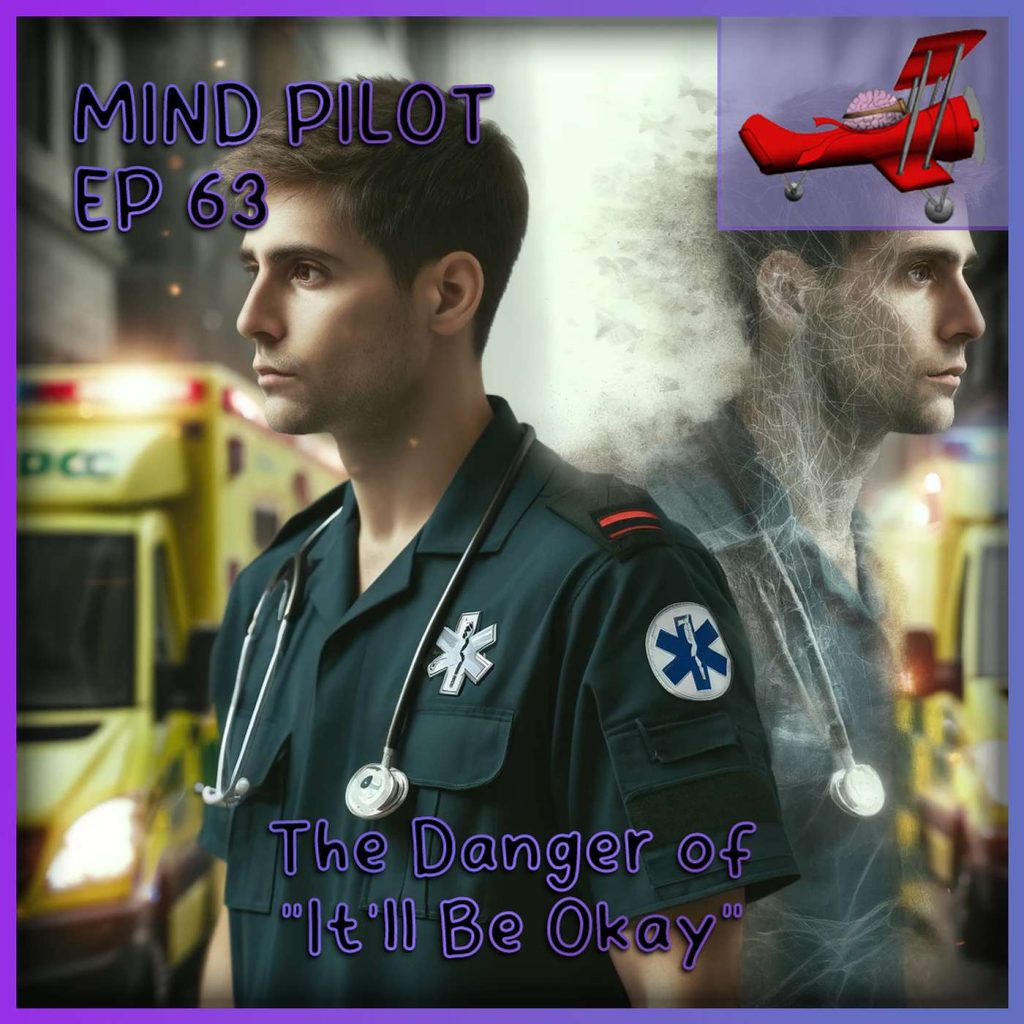
Mind Pilot Episode 63
In this episode of Mind Pilot, Dr. Jana Price-Sharps dives into the intriguing world of dissociation and its impact on our daily decision-making. Joined by Dr. Matthew Sharps, they discuss how stress-induced dissociation can lead to poor choices, often justified by the deceptive reassurance of "It'll be okay." Through real-life examples and practical advice, learn how to recognize and prevent dissociative thinking in yourself and loved ones. Stay tuned to discover techniques to maintain a healthy and connected life.
Topics Covered:
- DISSOCIATION: Exploring the concept and its effects on the mind.
- STRESS: Understanding how stress triggers dissociative states.
- DECISION-MAKING: Analyzing poor choices justified by "It'll be okay."
- PREVENTION: Techniques to recognize and avoid dissociative thinking.
Episode Transcript
Good day. Welcome to Mindpilot. This is Dr. Jana Price-Sharps. Thank you for joining us. Have you ever heard someone say, I think it'll be okay? Which really translates into, I'm going to do it even if it's a mess and I don't want to think about it. And please don't bring up that it's going to be a mess to me because otherwise I will be mad at you. Have you ever had that happen? I have. So we are going to discuss this today because this is a phenomena that I see all the time in therapy. And I see it with students, I see it with people that I'm friends with. And I've seen it with myself from time to time. So, but what is that? Why would we do that? So I've invited my favorite guest back, Dr. Matthew Sharps, and we're going to start the topic today with dissociation and what that is. And then I'm going to talk a little bit about how you can prevent yourself or how do you talk to a loved one who is doing this so that life runs better. So, Dr. Matthew Sharps, thank you again for being here today. Can you talk about dissociation?
Speaker 1Yeah, it's a fascinating phenomenon, really. It has nothing Well, it there is a thing called dissociative identity disorder, which has gone through a couple of names since then. But where the individual basically has quote unquote multiple personalities. That's not what we're talking about here. Dissociation is something that we find in everybody, whether they are subclinically or clinically. First responders are often a little lower on dissociation than most of us, but dissociation is one of the things that happens when you're under high stress, when you're under acute or chronic stress. And as you know, we both of us have written in several papers on the subject, and we still really can't define it very well. Nobody does. But dissociation could be construed as a kind of divorce from immediate physical reality. You could say that if you are thinking about other things so deeply that you miss your turn off, well, that's a bit dissociative, okay? If you're kind of well, you wake up in the morning in a motel. All motels are pretty much the same, whether Cairo, Illinois, or Cairo, Egypt is the same motel. For a few moments they're in that state of, where am I? Oh, it's a motel. Yeah, what where is that? Oh, yeah, that's that's that's that's such and such a town, Sacramento. Let's say, oh, I'm here for that conference, blah, blah, blah. So you come out of that s d that state, really. You could you could you could at least mimic the dissociative state with that. Now, this tendency to sort of divorce yourself from reality in a way, you're kind of dissociated when something supernatural feels like it might happen, even though it probably won't. And in fact, we studied that. We got interested in who would believe in in and see different paranormal things. We found that people who are depressed tend to believe in the space aliens and the ghosts. The space aliens might take you someplace nice, some better planet or something. The ghost mean there's an afterlife where things might get better. People with tendencies toward ADHD, and understand they're not sick. Okay, there's these things you can be sad and then you can be depressed. It's a smooth continuum, really, to a great degree. Um, people with tendencies toward ADHD, they didn't maybe not be diagnosable. They don't care about the damn space aliens. They want the ships. They believe in flying saucers, they believe in Bigfoot and the Lockingless monster because it would be cool. Okay? The coolest thing would be Bigfoot flying the flying saucer, okay? But the dissociated, those who are above a bit above normal, they're more dissociated than is typical. And these are normal people, they're walking around every day, they have jobs, etc. Um they believed in everything. They believed in the ghosts, the space aliens, the spaceships, Bigfoot, et cetera. And in a later study, we were able to show they not only believe in these things, they see them. Where everybody else sees a helicopter landing at an odd angle in the dark, they see a UFO. Everybody else sees a kid in a Halloween gorilla costume, they see Bigfoot. So this dissociative state is one that can really divorce us from reality, and it can really be a problem. A paper we've just published, it's in the 2024 January-February issue of The Skeptical Inquire, we found that dissociation actually changes the uh tendency to blame a victim for the crime against themselves, and it may also make people see the guilty as less guilty than they are. So it has immediate practical uh practical consequences for the criminal justice system, okay, in c in in concert with other contextual factors like the violence of the crime. So dissociation, it's not some kind of esoteric thing, oh, there's a a few psychologists interested in it, blah, blah, blah. It's there all the time. And it can cause you to see things not that aren't there necessarily. I mean, you're not likely to see the Loch Ness monster on a perfectly smooth lake. But to turn this ripple in the water or this floating log or something into the Loch Ness monster, and then be absolutely sure you found it. Okay. To see this person, well, you know, he shouldn't have been there at that time of night, or the the one you hear over and over again, right? She was asking for it. Okay, they'll tend to blame the victim for the crime. Okay. And the uh we also know that they will they will tend to fail if you're in a dissociative state, even not a sick one. There's nothing mentally ill here. But dissociation may uh prevent your seeing the flaws in arguments, the flaws in evidence. So it's a rather important uh factor, really.
SpeakerI think this is so important because if you're under high stress for a long period of time and you're exhausted, is it fair to say, Dr. Sharps, that you probably have higher levels of dissociation?
Speaker 1Aaron Ross Powell That's known. Work by Artwall showed that very clearly. And Klinger as well. And uh Lieutenant Colonel Grossman wrote on that in his in his books. I've written about it from the cognitive standpoint in my books, Processing Under Pressure, which is for law enforcement and thinking under pressure, which is for the fire service and other emergency workers. Um we we we find the same thing. Dissociation is a moderately likely uh uh likely uh consequence of being under typical law enforcement stress. And as I've said before, the there's continuity in the nervous system. Okay. I know that the duties and even the attitudes of firefighters will be very different from those of law enforcement, maybe very different from those of the military of combat troops, maybe different from ambulance personnel and paramedics. But the physiology and the psychology are continuous. Okay, what happens to the one service happens in the other. Okay. And dissociation is a relatively common, not not perfectly common, but certainly not rare, a relatively common phenomenon that occurs under the stresses the first responders routinely encounter in the field.
SpeakerSo let's say somebody is getting off duty and they don't really want to go home right now, and maybe they got off early in the morning, maybe their family isn't up, or maybe they got out off in the middle of the night for whatever reason, and they're driving home and they go, you know what, I'm just gonna go into that bar I used to go to. Yeah, I haven't gone there for a long time, but I probably shouldn't drink so much, so I make sure that I don't, you know, drive while I've been drinking, but I'm sure it'll be okay. Those are the kinds of decisions people make. Oh, you know, she's so pretty, she's so nice to me, you know, my my wife doesn't really love me anymore, you know, nobody's gonna really know about this. I think it'll be okay. You know, the gambling, oh, you know, I I know things are tight this month, but I could probably make that money up if I gambled a little bit. Now they're down a couple hundred bucks, they probably should stop. But they go, I think it'll be okay. I have noticed over the years that when people say, I think it'll be okay, there's a part of their brain that is typically screaming, this is not going to be okay. Please stop. Don't do this. What the hell are you thinking? But they don't, and they use it's almost like they use that statement to shut off that part of the brain so that they can continue on and do whatever disastrous thing they're going to do. Is that a fair statement, Dr. Sharps?
Speaker 1Yeah, you see that all the time, absolutely. Okay. So part of you is saying, no, let's not do this for God's sake, and part of you is going, it's time for the rodeo. Yeah. And part of that can be a consequence of arousal. Now, that said, dissociation as such, it really hasn't been addressed empirically in those areas. Let's say, you know, let's you know, stop you in the middle of your extramarital affair and fill out these forms for us. It's very difficult to get people to do that, okay? But I will say this: it's certainly consistent with the idea of the heightened uh dissociative state that we see with arousal, because you're not seeing reality as it is. I've seen that uh a number of times, for example, in climbing situations. Oh, I'm sure it'll be okay. I'm sure there's a route down this rock, and there isn't, and suddenly you've got a rescue job, okay? I'm sure it'll be okay to go over those rapids in an inn or two when we really should be in a dam raft and you wind up with the rescue job. Uh this is not uncommon, okay? And obviously, if if you are in a marital relationship or a serious relationship, and you suddenly discover you'd rather be having sex with somebody else, well, there's going to be a high arousal situation there that is at least consistent with the kind of dissociation we see tactically. One difference here is that law enforcement people, and uh our measurements anyway, are they don't tend toward dissociation. They wouldn't be successful in their field if they did. But this is one of those things where I just want to say anybody under higher tactical stress, dissociation is going to be higher. This is a work of artwall, the work of Klinger and of Grossman. Um, very clearly, you're more dissociated than we would be otherwise. You're more going to entertain things that might not be true. An obvious question is, why in the hell is the human nervous system arranged this way? Because if you're about to be eaten, back in the ancient world, you're about to be eaten by a saber-tooth tiger, and you decide, well, it'll be okay. The saber-tooth tiger wants to know if you taste like chicken. Okay, so it's a really stupid thing to do. But suppose we want to go you to go into battle against a vastly superior force. Wouldn't it be nicer not to question that the the Valkyries are going to come and take you to Valhalla or Odin will honor you? You don't really want people going, wait, these Valkyries, how do they fly? You know, what's what's the airspeed velocity here? You don't want people asking those questions. Okay? That dissociative state may help to put you into the nice berserk Viking state that you need to be in, to do things that may get you a medal, but that from an objective standpoint may might be viewed as incredibly stupid. Okay. So we think that may be well, I think it was something it it's at least reasonable. It's a high reasonable hypothesis that dissociation had that utility so that you could uh momentarily enter a mythological realm where it'll be okay. And it's very similar to that realm when you're you know down at the dewdrop in uh mating with somebody you probably shouldn't be. Or when you are about to do something like, oh, I'm sure it'll be okay. Let's take this previously unknown non-existent route up this mountain, because I'm sure it'll be okay. Um dissociative states. I don't know. Again, I'm I'm not suggesting that people are hanging there from ropes and carabiners and we suddenly give them the DS DES2 to fill out, but it's at least consistent with everything we say.
SpeakerOne of the techniques that is very helpful, first of all, I want you to put a red flag, so to speak, by that phrase. Anytime you hear yourself say, Oh, I think it'll be okay, that needs to be flagged in your mind of, wait a minute, I need to stop and really think about this because why am I saying this to myself? Am I saying this to myself because I want it to be okay, because it looks like fun, or am I saying it because I have evidence that it really will be okay? Two different things. One of the things, one of the techniques that I'll use, let's say I have a person, male or female, who is in a long-term relationship and they're thinking about having an affair with that new person they're working with or a new person they've met. And I will do what Dr. Sharps calls a feature-intensive analysis with them. I'll say, okay, well, let's say that you do that. Let's say that you uh see this person tomorrow, and you talk to them, and you're thinking about how wonderful they are and how nice they are and how they're saying all those good things to you, and you make a date with them, and then maybe you make a couple more dates, and then you do a couple more things with them, and then you end up, I don't know, at somebody's house or at a hotel room or whatever, and then you are intimate with them. And about that time I say, How are you feeling? And the person is going, Yeah, yeah, that's good. Okay, that's really good. All right, yeah, that'll be fun. And I'll say, Okay, so now you have to go home. And your significant other or your spouse meets you at the door and says, Hi, honey, how was your day? And the tendency is to get mad at that person because they're that makes you feel guilty. So they say something like, I'm fine, why are you always nagging at me? And they start a fight with that person because they don't want to talk to that person because now they feel guilty. And then they meet with that other person again a couple of times. And then, oh, by the way, it's a holiday. So that other person says, Well, you're gonna spend the holiday with me, aren't you? And you say, Well, no, I've got to spend it with my wife or husband and kids. And they go, Well, what about me? Why is me? And and so now you're in that between a rock and a hard place, and now what do you do? And you're gonna make somebody mad. So you just do you spend half the day with your family and then sneak off and go half the day with the, you know, the new love? Oh, okay. So now six months into this, that new love is saying things like, Well, when are you going to leave your spouse? When are you going to get a divorce? You don't really want to spend Saturday with Johnny and celebrating his birthday, the five-year-old. Uh, you want to spend it with me. And now you end up in this double bind. And three years from now, when your spouse finds out or your significant other finds out and they leave you, and now you end up in a long-term relationship with this person. And guess what? Now you're talking about the car payment, the PGE bill. You're talking about what Susie needs for her birthday. You're talking about you don't have enough money to go on vacation because, oh yeah, you have alimony and child support payments. Yeah, see, when we say to ourselves, yeah, I think it'll be okay, you really need to think about a feature-intensive analysis. Is it really going to be okay? Or is that just you shutting down your brain because you want to go play? My suggestion is you find a healthier way to play and stay away from it'll just be okay. I hope you have a wonderful day, and I really want you to think about your life and stay connected to it because you have the right to have a happy life. Thank you for joining us. This is Dr. Jana Price-Sharps from Mind Pilot.