Have feed back, suggestions, or questions? CLICK HERE to Send us a Message.
Mind Pilot Episode 57
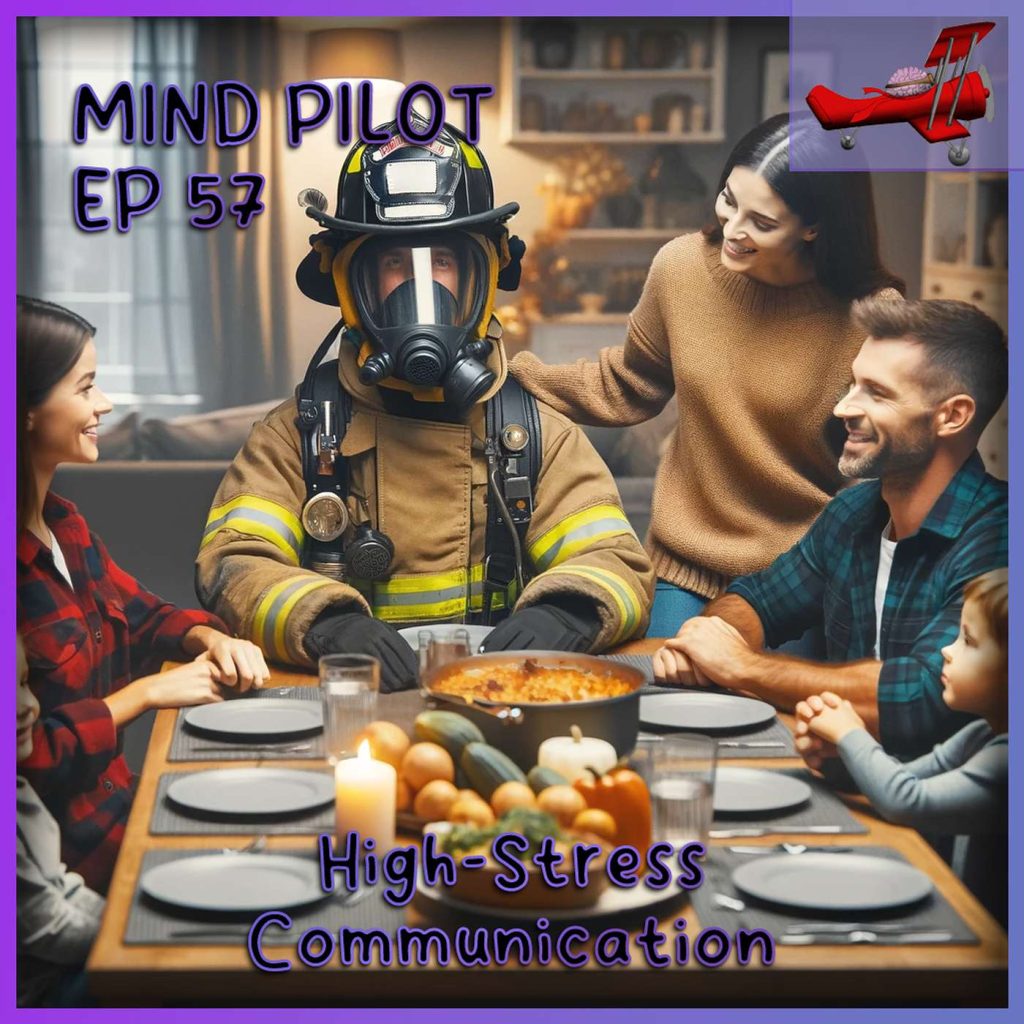
In this enlightening episode of Mind Pilot, Dr. Jana Price-Sharps and returning guest Dr. Matthew Sharps delve into the complexities of high-stress communication and its effect on conflict resolution. They explore the physiological and psychological responses in fight or flight situations, discussing how stress impacts cognitive functions like memory, decision-making, and impulse control. The conversation also offers practical advice for first responders and others in high-stress jobs, emphasizing the importance of de-escalating arousal levels for effective communication at home and in the workplace.
Topic covered
- FIGHT OR FLIGHT: Analyzing how stress triggers the fight or flight response and its impact on communication.
- IMPULSIVE SPEECH: Exploring the tendency towards impulsive speech under stress and strategies to manage it.
- COGNITIVE IMPACT: Discussing the effects of stress on cognitive functions and decision-making.
- TRANSITIONING STYLES: Tips for transitioning communication styles from high-stress environments to home life.
Episode Transcript
Good day. Welcome to Mind Pilot This is Dr. Jana Price-Sharps. Today we're going to talk about a topic that you're going to hear a lot about on this podcast. Over time, but we're going to dabble in it today, navigating conflict. And so today we have a guest speaker. He's been on our podcast a number of times and Dr. Matthew Sharps. And we're going to talk both about what happens in fight or flight in terms of communication. Then I'm going to talk about wording that can be used during communication that will help reduce conflict. So welcome, Dr. Sharps. So when people are stressed, how might it impact their ability to navigate conflict? Well, when human beings are stressed, the mind basically changes a great deal. You have what we refer to as the fight or flight response, where the body becomes more adrenalized and there are other chemical changes that help you negotiate what might be a violent or might be a situation that requires you to run or what have you. Well, if you think about the brain and the body, the body's using a tremendous amount of blood, but the brain winds up using the brain's an enormous energy hog. It weighs about 2% of your body weight, but it uses about 20% of your blood borne resources. So under the situation of stress where you need you want even more blood to your muscles, you start to reduce some of the resources available to the brain. And the problem is many brain areas, you're really don't want to reduce that much if you're fleeing or fighting a fight or flight response. You want to still be able to see and hear and know what and where things are and coordinate your your motor motion. You're at the activity of your body, which means that there is a good short change. Are often those involved in your ability to think and monitor and consider things. Now, in fact that probably had quite a bit of utility in the ancient world because if you're not thinking as much in a fight or flight situation, you may want to be a little braver. You may want of attacking the sabertooth tiger rather than going, my goodness, maybe I should negotiate with it. Okay. Well, the problem, though, in the modern life of the modern world, the world of humans, as we are now, and civilizations. The difficulty with that is that it reduces your power of thought. It'll reduce some of your ability to formulate coherent arguments and discussion. So there'll be a tendency to yell or to say, Don't do that. And of course, we may also become and behave in a more aggressive manner. So the gist of it is that under stress, you're fairly likely to start behaving in a negative manner, start shouting at people, lose the ability to monitor what's going on around you in terms of conversation. What effect am I having on other people? How am I doing this? There'll also be interesting problems with, frankly, with with memory, with monitoring our own behavior. What if I said under what circumstances if I said, you know, how well does this work? The last dozen times I tried it? So all these stress related responses will tend to mediate against successful conflict resolution. Successful, successful mediation. Do people tend to blurt out things when they're under high stress? Yes. This is one of the things that's been found work by psychologist Art Wall, work by Colonel Grossman and others who've worked on this. One of the more common things that happens under stress is this tendency toward impulse passive speech. Okay. You'll get an idea and it just has to be expressed. Okay. Well, it's kind of strange that you're not really monitoring your behavior enough, and suddenly you get this idea of I must say this. And if what you must say is to, you know, call your boss a human hemorrhoid or something. This is not going to be good for your future. So this impulsive speech becomes a very big problem. Lots of first responders have said the wrong thing in an emergency situation. It's been picked up by some news source and they've been in great, great trouble as a result. Okay. So if a person is kind of chronically stressed, does that differ from somebody that is situationally stressed? As for in terms of impulsive speech. That's an interesting question. I don't know if there's really much research on it, because what we're dealing with here is really more, I think, the level of stress than whether it's chronic or acute. Obviously, chronic stress will have graver, graver consequences for your health and so forth than most other forms of acute stress. But that's more a question of the intensity of the stress. And certainly what we see in the literature, if I'm thinking about it, is more discussing those, the sudden blurting out of something very negative under acute stress, but at the same time, long term chronic stress, it's going to start to erode your abilities to think well and to monitor how you're dealing with other people. It may result in situations where you fall back on more habitual thought, and action of those habits are negative. If you've learned in a family situation, for example, if learn to yell at people or potentially be physically abusive, there maybe there may be other may be a tendency to fall more back on that when you are highly stressed. These are things by their nature. There's been a lot of experimentation on this. We seem to see across across the entire field. Okay, So clinically what I have seen is first responders get used to a certain pattern of communication in the workplace. So they may be giving orders, they may raise their voice, they may sound very curt, and they're not going to spend a lot of time thinking about, gosh, I think that might hurt Syd's feelings. So I'm not going to say that. And then they transition home, but they haven't transitioned their communication to home life, and they're still high on that, what we call a Yerkes Dodson curve, that stress curve. Is that going to impact their communication at home? I have seen it clinically. Is there some reason, brain wise, that it's going to be impacted? Well, absolutely, because if you've been in the Central Command, the situation obviously were, you know, about a forest fire where dry chunks of fire are falling out of the sky as trees are burning. Right. Or a SWAT action or something that was this terribly intense long term situation and sort of lethally dangerous and bring up a lot of ethical, ethical questions on the part of the law enforcement officer, him or herself. Yeah, You don't you don't spend a lot of time under those circumstances saying, please, thank you and pass the tea. Okay. Most of your communication very direct and that's often pretty damn loud so that the people in hairy over the dozers and the fire and the shooting of that. So you get home with that and so you come through the door and you kind of expect your family. good, I'm home and the family is going to be nice to me. You know what the family is often going to do is start making immediate domestic demands on you. Why did you leave me with dealing with this and that and the other? Lots of first responders, not all, certainly, but lots of first responders simply don't share the more stressful aspects of the job with the family. The family may not really know what they do for a living, but they do know that the family is not behaving the way the family is expected to. And they may start to get angry and they may then go back on their arousal habit patterns. You start looking around, you realize the house wasn't that clean. The child rearing patterns seem a bit feral to you, and you start giving commands and orders to your spouse as if you were talking to subordinate officers or to colleagues where you were directing their actions. Most people expect please thank you and pass the T not taking direct orders. They'll get angry or angrier. And unless you're really monitoring that intellectually, you're monitoring it with your full intelligence, which is exactly what we can't do when we're under high stress. It's likely the entire entourage is likely to accelerate in terms of hostility to potentially quite a degree. That makes a lot of sense. It's really important to think about what your level of arousal is and if you're headed home or if you're headed in to maybe an office to speak to a supervisor that you really take a few minutes out when you can to do that transition. And we talked about transitions in one of my other podcasts, but that 5 to 10 minutes of, I don't know, listening to comedy, listening to happy music or looking at pictures of your best vacation you've ever had, anything that will cool your system down before you engage. Because if you engage when I call it running hot, when you're fully adrenalized, stuff is going to come out of your mouth. And the problem is you can't take it back. And so it can have long term repercussions for your relationships. So one of the best tips for this is really start being aware of levels of adrenaline. And I have found over and over and over, when first responders start to cool their system down, they're taking those breaks. They're doing some fun things. They're laughing, they're getting away from work, they cool down, never sleeping. They're feeling better. Their communication is significantly better. But they also are much more aware of where they're at on their arousal curve. I often will have guys come back after they've done a really good job of cooling their system down guys and gals, and they'll say, Man, I got really adrenalized in such and such an event. And boy, I didn't realize is that the way I used to run all the time? Yep, sure is. Wow. No wonder my whole family was mad at me because I felt horrible. But now I see it. I think before I was just living that way and I didn't even notice it. That's actually very true. If you go from incident to incident to incident, you're not taking your time off. You don't have any vacations. You're not going to notice that you're highly adrenalized. I believe you've said it before, Dr. Sharps. Fish don't discover water. Yeah, that's very clearly true. When I was writing my most recent book called Thinking Under Pressure, specifically about these issues for the fire service. Weird coincidence. I was having a lunch of a leftovers from a Chinese restaurant meal, and I break in the fortune cookie. The Portugal beach paper there says delay is the antidote to anger. So you're going, Wow, because I don't want to go in like this pathetic fortune cookie or this. They want to in the book because it's true. If you can make that delay, you get out of your vehicle and you're coming home when they don't know you. And other clinicians have recommended three or five card taped to the door, not to the windshield, you're going to distract you when you're driving. But and this may be different for different people, but something like the word delay question mark or the term, how are you doing something? It depends what the individual needs. You're going okay, No, I'm not really in shape to go inside right now. I need to take a walk and then you might, because you're very highly adrenalized. You may need other steps written on your card. If you need time, comma, call your spouse. And you might because you know, you know they don't want the spouse thing a year avoiding them. But this is one of the reasons why I know you want to have the spouses involved in any kind of interventions with first responders if possible, because, you know, something like, you know, I need a few minutes to say, really, you know, it really, really, you know, it really maybe the word isn't quite absurd, but I'm really not doing too well after whatever the incident is. I'll be home in a few minutes. I'm going to get out of the pond, sit down, feed the ducks, whatever you know, whatever you do, DeLay can be the antidote for anger because, well, we always talk about it as having a prior explicit framework for understanding what's going to happen next. But often that framework is going to need time. Know first responders. Generally, your responses, I'm going to move on this. I'm going to move on this right now. I'm going to move fast. That's exactly the wrong thing to do under these circumstances. It's a question of installing a completely new mental set, a new habit of mind if you're enough on the line or in the field or whatever my job duties are, yes, I may have to move and I may have to do it. I may have to do it now, But that may not be the proper approach when you're coming off the lines and you are, you know, going home after a long, a long absence delay is the avenue for anger, frankly, that that without written a revision of the fortune cookies and pasted on your by factor, that could be very handy. Absolutely. I'm forever telling folks, if you've had some major incidents at work and you know you're wound up or maybe you had an argument or maybe you had somebody attack you or whatever happened and you're headed home and you know you're running hot, send your spouse a text. You know, maybe you don't want to call them because maybe you have the kind of spouse that goes, well, what's wrong? What happened? You know, maybe you just send them a text and say, look, I had a really bad day at work. I am going to take 15 minutes out and I am going to go sit in the sauna at the gym. You know, whatever it is, I will be home at this time, but I need to decompress before I get home and have that talk with your significant other spouse before this happens, because they need a prior framework for this as well. So don't just do this the first time when it's happening. Sit down with your significant other, your spouse, and on a Sunday morning when you're having coffee or whatever and say, you know, here's what I would like to do. I don't want to come home angry and wound up. Because when I do that, then I say things that I don't mean and I hurt your feelings. So if I've had a bad call or I'm really wound up, you're going to get a text from me and it's going to say, I'm going to go sit in the sun at the gym for 15 minutes. I will be home. But I need I need to cool my system down, whatever that means to you. Go to the lake and feed the ducks, whatever. And that needs to be a code with a significant other. okay. All right. So he. He or she had a bad day. They'll be home in a little bit, you know, because if you call them and say, look, I'm all you know, and then then it will often go into a fight I have found. So do the text message, but agree upon that before this ever happens so that both of you are on the same page, but it will mean that you're going to communicate much more effectively and you're not going to find everybody in the household is now avoiding you, because that's one of the saddest things that I have seen as a clinician, is the family starts avoiding the first responder because the first responders so angry all the time. And really it's they're not sleeping. They haven't taken their vacations, they haven't had any downtime. They haven't done anything for fun, and they're exhausted. So we talked a lot about that on the other podcast. Take care of you. Take care of your health, take care of your mental health, but also go have some fun play depending on what you believe. We have one life. Make the best out of it. Do some things that you enjoy with yourself and with your family. You deserve to have a happy life. So take care of yourself. Catch up with this on Instagram, on YouTube, on Facebook. We're going to have a lot of additional training available soon. We look forward to working with you. I hope you have a wonderful day. This is Dr. Jana Price-Sharps. From Mind Pilot.