Have feed back, suggestions, or questions? CLICK HERE to Send us a Message.
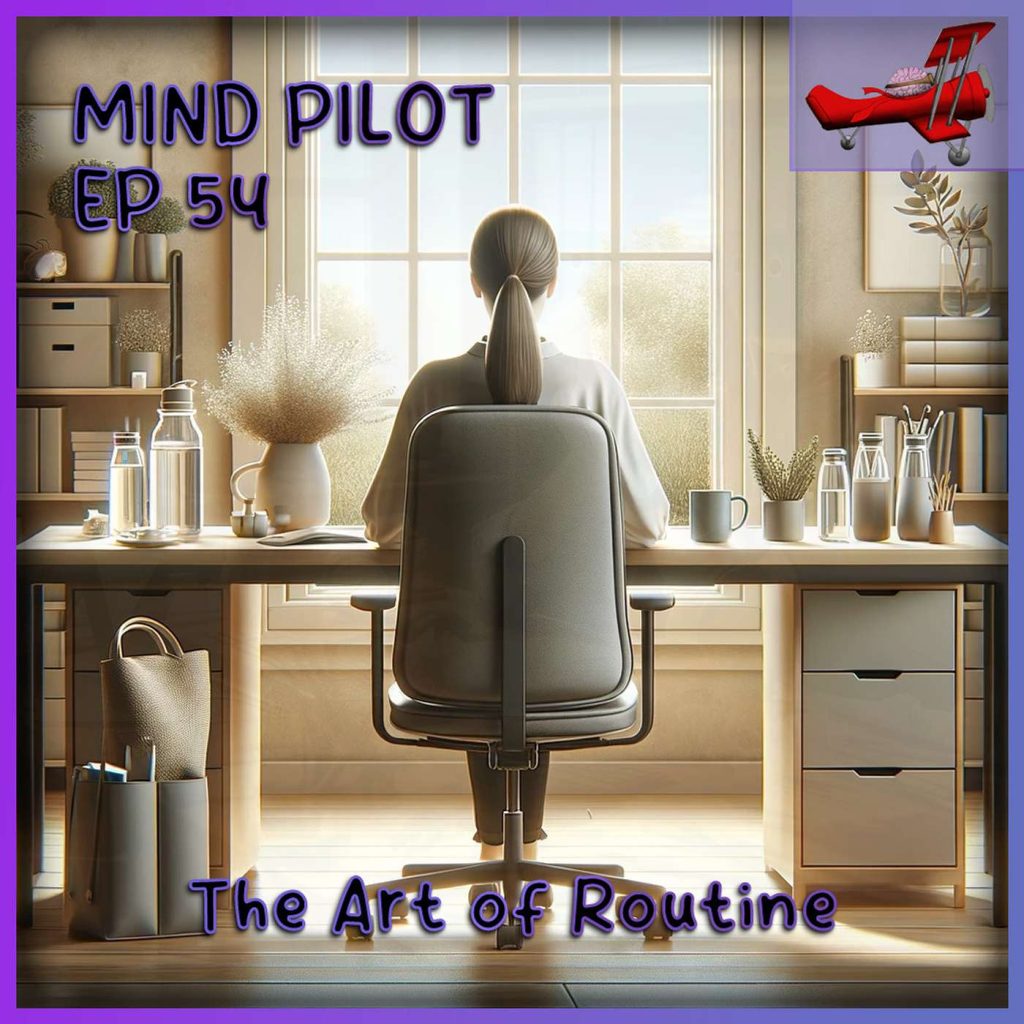
Mind Pilot Episode 54
Join Dr. Jana Price-Sharps in this episode of Mind Pilot, where she uncovers the secrets to mastering daily routines for improved health and well-being. Dr. Price-Sharps sheds light on the importance of quality sleep, the role of diet, and creating an environment conducive to productivity. From the intricacies of circadian rhythms to effective strategies for transitioning between work and home life, this episode is a treasure trove of tips for anyone looking to enhance their daily routine. Discover how small changes can lead to significant improvements in your life.
Tags: #Health and Wellness, #Productivity, #Life Optimization, #Mental Health
Bullet Points:
- SLEEP PATTERNS: Examining the impact of sleep on overall health and productivity.
- WORKSPACE HABITS: The importance of comfortable work environments and regular breaks.
- DIET AND HYDRATION: Discussing the effects of diet choices and hydration on cognitive functions.
- MENTAL TRANSITIONS: Strategies for effectively transitioning between different life roles.
Episode Transcript
Good day. Welcome to Mindpilot. This is Dr. Jana Price-Sharps. Today we're going to talk about healthy routines. That may sound kind of odd, but I want you to take a step back and look at your life and think about the routines that you currently have. Are they routines that help you? Or are they routines that cause you problems? And it takes some thinking sometimes because a lot of times people say, No, I'm good. I'm good. Everything's good. But then they start really thinking about, for instance, I'll give you a typical one. Yeah, I sleep enough. And then when they start really thinking about sleep, they go, Well, I go to bed at 10 and I get up at six, but actually I don't get to sleep till about 11:30. And then I wake up in the middle of the night for about 45 minutes. And then often I wake up at 5:30. Okay, so when you think you may be getting seven or eight hours of sleep, in reality you're getting five or six. Now, if you're young and you're listening to this podcast, you can get away with that for a while. You're not going to function as well as if you had a full night's sleep. But your body is going to repair itself a lot faster if you're 21 than if you're 40. So thinking in terms of what can you do to make your life the best it can be because you deserve that. So sleep is a big one. And I know I say this almost every time, just because the sleep research is overwhelming about how it impacts overall health, quality of life, memory and concentration, mood, every aspect of our lives. But there's a lot of other things. You know, I know you've all heard, yes, make sure that you're, you know, managing your diet. You know, living on fast food only is probably going to have toxic effects eventually on your system. But I'm also talking about little habits. For instance, let's say that you have a bunch of paperwork to do today. And maybe you're like me and you don't particularly like paperwork. Okay. Do you set it up so when you're doing the paperwork, it's a comfortable place to do it? Have you paid attention to your overall health before you start something that you don't maybe particularly care for? In other words, did you eat before you started this project? Did you drink enough water that you're hydrated? Because they're finding a lot of people are slightly dehydrated and they don't know it, which can affect memory and concentration. Have you set it up so your chair is comfortable? A lot of times people don't think about that. But when you talk to people that actually work uh in the IO industry where they're checking out whether or not the chairs are suitable for the person, do they stand enough? Do they need to stand and then sit? Are they checking that out in your own life before you start? Are you taking those five-minute breaks? And it is amazing. When I first heard this, I was I kind of grumbled because that's my want in life, I think. But when you take that five-minute break every 50 to 60 minutes, it is pretty amazing how it impacts your ability to focus on whatever it is you're focusing on. A lot of times people really get hyper-focused and then they sit there for four hours and then they just crash. And they don't have that mental revival that you get when you take those five-minute breaks. What do you do during those five-minute breaks? Who knows? There's a lot of different things you can do. You can get up and you go get some water to drink, go uh just walk around the block one time, uh, sit and meditate for five minutes, uh, stand up and do some stretching exercises. But they have found that people that do this on a regular basis feel so much better. And when you come back to whatever you're working on, you're so much more focused than you are when you don't do that. That's one kind of healthy routine you can add in. What's another one? When you're going from work to home, do a transition. It doesn't matter where you work, what you do, transition into whatever your role is at home. Are you a mom? Are you a kid? Are you a dad? Are you a sibling? Transition into those roles. Get your mind ready for when you walk into the house. Okay. It doesn't have to be this major event. Maybe you just think about what it's going to be like when you get home. Not thinking about, oh my gosh, it's going to be terrible, but thinking about, oh, I need to check in and see how my significant other or my spouse did today and how I know they had a big report due. And I wonder if that got done and how that went. Something like that. You begin to transition your mind. So often we end up trying to connect with our loved ones when we're really harried, right? Where our mind is just still going, we're still at work, we're still thinking about work. You know, one of my favorite motivational speakers was Zig Ziggler. And one of the things he said is so often when people are at home, they're thinking about work. And when they're at work, they're thinking about home. And so they're really never anywhere. And I thought that was a really good quote. And I've always remembered that. And I think it's true for a lot of us. We don't take those minutes to transition into that new whatever it is. So transitions are also useful if you're, let's say you are doing paperwork and now you're going to go and I don't know, maybe you're going to the store and buying some groceries. Transition your mind. Give yourself a couple minutes to go, okay, I've got my paperwork put together. You know, my desk is neat. Now I'm going to go. I've got my grocery list, and now I'm going to go to the grocery store. If you're first responder, maybe you go, okay, I got done with that call. I have a few minutes break. I'm going to stretch a few minutes and then I'm going to go in and do some paperwork if you have time. You know, does it always work out that you have that time? No. And I get that. But when you do, adding those transition moments can really help revitalize you. What are some other things that you can do? Well, thinking about circadian rhythm, right? A lot of people, their blood sugar will drop in that somewhere between two and four in the afternoon, right? That's why, you know, a lot of Europe has uh high tea, you know, uh Mexico has siestas. There's a reason for that, because that's when people's energy level slips. So be mindful of how your body is responding. If you find that there's a certain time in the afternoon that you're starting to have reduced energy, maybe that's a time you take a 10-minute break. Maybe that's time you take a 20-minute nap if that's possible in your life. Maybe it's a time that you make some tea, or you know, maybe it's a time you stretch. Start working with your body. When you start working with your body, when you start listening to your body and what it's telling you, your productivity is going to go up substantially. So those are just a few healthy routines. We're going to talk about more throughout this podcast. But those are kind of starter routines, those are the basic routines that really seem to help people. It's borne out in the medical research, it's borne out in the industrial organizational research as well. So I hope you found that helpful. We are now on YouTube, so check us out. And we are going to start being on Instagram and Facebook. So please follow us. We're going to have some awesome opportunities for you. So keep in touch with us. Let us know if there's something that we haven't covered that you'd like us to cover. And in the meantime, you have the right to have a good life. You have the right to have a healthy life. Please take care of yourself. This is This is Dr. Jana Price-Sharps from Mind MindPilot. Don't forget to subscribe. Okay.