Have feed back, suggestions, or questions? CLICK HERE to Send us a Message.
Mind Pilot Episode 27
Dive deep into the psychology of behavior with Dr. Jana Price-Sharps in this intriguing episode of Mind Pilot, featuring Dr. Matthew Sharps, a seasoned cognitive scientist and professor at Cal State Fresno. Discover the often-unconscious forces driving our actions through the concept of 'pairing' as Dr. Sharps elucidates classical conditioning and its impact on everyday life, using compelling examples from both humans and animals. Unveil the subtle ways our environment and experiences shape our reactions, from firefighters' responses to smoke to the workplace dynamics that affect morale. If you're interested in how latent learning can change our behaviors in ways we barely notice, this episode is a must-listen. Don't miss out on these profound insights—subscribe now and learn to navigate the complex pathways of your mind.
Topics Covered:
- UNDERSTANDING BEHAVIORAL PAIRING: Dr. Matthew Sharps explains the concept of pairing and its subconscious role in driving human and animal behavior.
- CLASSICAL CONDITIONING IN DAILY LIFE: Explore real-world examples of classical conditioning, from firefighters' reactions to smoke to the dynamics of negative workplace environments.
- LATENT LEARNING REVEALED: Uncover the power of latent learning as Dr. Sharps shares personal anecdotes and scientific insights on how unrecognized environmental cues shape our actions.
Episode Transcript
Welcome to Mindpilot. This is Dr. Jana Price-Sharps. Don't forget to subscribe. We have a guest again today. His name is Dr. Matthew Sharps. He happens to be my husband, but he's a cognitive scientist. He is a professor at Cal State Fresno. So today we're going to talk about pairing again. And we did a podcast earlier about this. And pairing is so important because it drives so much of our behavior. And a lot of times it's driving our behavior in ways that we're not aware of. So I'll give you a simple example of pairing. If you have worked in the fire service and you smell smoke, your body is immediately going to ignite with adrenaline and go into a danger response, more so than a civilian. Civilian will have that response as well, but you're going to do it more so. So it's important to understand that relationship. So I've asked Dr. Sharps to be here to talk a little more about what happens when we have pairing going on with our brain. So with that, can you please talk about some of the behavioral aspects of pairing?
Speaker 1Yeah. The nature of the mind is such that you wind up needing to make associations between things. And then often relationships between those things and higher levels of categories. You recognize that a knife and a fork and a spoon are all silverware, or you could also recognize they're all used at the table. But the kind of thing we're talking about here is substantially more primitive. It doesn't necessarily need reference to higher levels of cognition. What we're really talking about here has been studied for about a century now, the nature of conditioning and learning, and there are several types of that, but the important factor is here that these types of learning can be demonstrated in nonhuman animals, creatures that do not have the ability to think at high levels. Classically we saw the work of Pavlov with the dogs. Well, dogs are relatively bright, but what happened there was Pavlov showed that when the dogs got their food, uh the uh the technicians had to r buzz themselves in. The dogs initially started to drool at the buzzer as they had to the meat because the buzzer was now associated with the meat. But that kind of learning has been demonstrated in even uh animals that are not as intelligent as dogs. I know of zookeepers who've talked about literally conditioning snakes, teaching them pairings of things, and there's some evidence of this even in certain invertebrates, although that's uh that's a different area. Now my point is this: you don't need human consciousness for many kinds of pairing, but often we uh we have those learning mechanisms available to ourselves as well.
SpeakerSo how might that affect a person in their daily life if they've gone through a lot of traumatic events or critical incidents, I guess I should say, how might this impact them on a day-to-day basis?
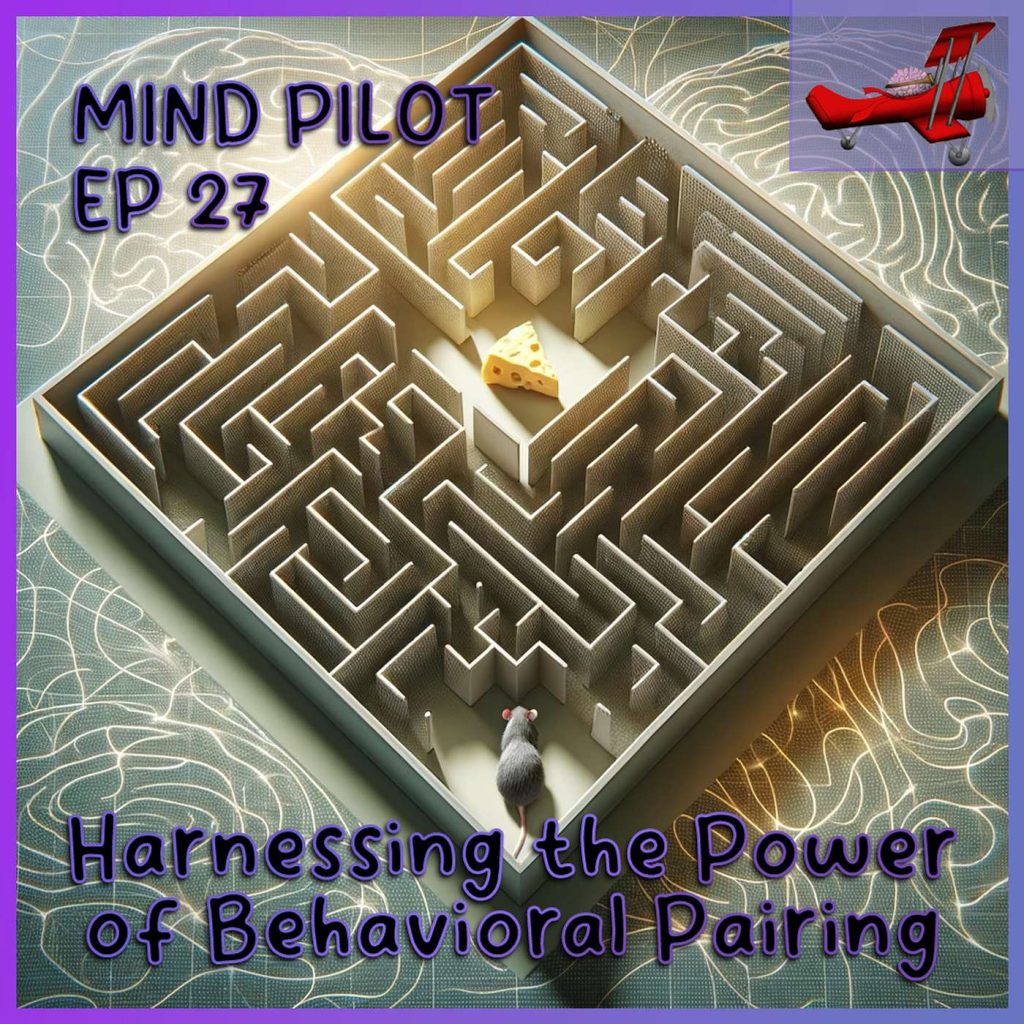
Speaker 1Aaron Ross Powell That's a good question. The kind of learning, the kind of pairing we were just talking about, the kind of thing that Pavlov did with his dogs is called classical conditioning. But there are two other broad categories of learning too. Now one of those is instrumental or operant conditioning. That was pioneered by B. F. Skinner. And in operant conditioning, yeah, well, it's literally instrumental. You might receive a punishment. There's another phenomenon called negative reinforcement we won't deal with here, but or positive reinforcement reward. If I get a reward for doing whatever it is, I will do more of it. If I get punished, I'll do less of it. I myself worked with pigeons many years ago as an undergraduate doing this, and we could easily get the pigeons to do things if we give them an explicit or implicit reward of actually an explicit reward, I should say, of uh basically feed. Now, why is that important? Consider a human being who, when walking into, for example, a fire station or police station, or a negative family situation, you get quite a lot of negative stuff there. The punishment, so to speak, is implicit. Nobody's giving you electric shocks or anything like that. But the disapproval of uh the people around you for certain actions, et cetera, et cetera, you're going to start to pair the fact is when you get up and start thinking about going into work, you may start feeling negative because of what's happened to you under those circumstances. Now, this is not going to be entirely conscious. Lots of times people just feel happy when they go into a situation where things have been nice for them in a way it's been reinforcing, given reward, or going into a situation that where they've had negative pairings, negative experiences. I think many people have had the experience of being in a room where the boss was mean to them or something, or their colleagues wouldn't share lunch with them or something. Next time you go into that lunch that break room, you may just start to feel I don't really like it here. I don't know why. And that's happening at a level, I don't want to use the term below consciousness because it's a little too oversimplified, but it's a level that does not reflect human consciousness. I think I can demonstrate this most clearly, though, with the third major type of learning, latent learning. And in latent learning, that was pioneered by the psychologist Tolman, you have learning, pairing in this case, I'm sorry, pairing, where you don't have any reinforcer, any reward or punishment, or any association like Pavlov's dogs made with the bells and the buzzers and the meat powder, either, the meat, either. A good example of this, and bear with me for this if you would, is in a modified tea maze, you can train a rat always to run to the left arm of the tea maze. He starts out at the base of the T. Let's say his rat food is always on the left side of the arm of the T, and something negative or just no food is on the right side of the T, okay? Well, the reason we call this a modified T maze is imagine a letter T that's an actual maze. Your rat starts from the very bottom of it, but imagine there's another arm going off to the right or the left before you get to the crossbar, okay? Now, no time does the rat ever get rewarded or punished for noticing or not noticing that little tunnel off to the side. It's just completely outside his world. It shouldn't matter to him. But now this has been done many times. Suppose the rat is there in the team's, and we start approaching him from where the crossbar crosses the upright with a feared stimulus, something like a toy that's coming toward him, making a lot of noise. The rat doesn't just huddle down at the bottom. What he does is run toward the feared stimulus, and then he ducks down into the little tunnel on the side and lets it go on by. The point is, the rat was never given any, if you will, conscious awareness of that little tunnel off to the side, and yet he has learned it. He's paired it with what? Okay? It's not been paired with anything specifically, but it's available. Now, why this comes in rather important is there's a specific airport that I used to have to go through a lot that basically is a T-As. You have to run down this corridor to get to where your plane's taking off. Well, many years ago, there was a group of people who were practicing a specific religion that were very aggressive about it, and I was running like heck to catch my next aircraft, and they were coming toward me. I thought, look, I am not in the mood for this, okay? And so what I did was I ran straight toward them and I ducked off into a men's room to the side, and they went on past me, okay? And I thought to myself, my God, I'm a rat. Because the fact is, whenever I'd been running through that airport, I'd always been running too fast to even notice that men's room. I could have literally sworn I didn't know it was there. But when I was suddenly threatened with enlightenment and demands for money, I escaped enlightenment by ducking off to the side into a little tunnel that was basically an a modified team's. Now I could have gone into court and sworn I did not know if there was a restroom there. This was not at a level of human consciousness, like I realize that forks and spoons are both silverware or that you use them at the table. We're not categorizing in that sense. This kind of pairing is very, very I don't necessarily say the word primitive, but it's much it's it's at a level below the level of conscious cognition that human beings are capable of. Now that becomes important because suppose I enter that break room where I had bad experiences. Well, if I can explicitly give have a prior framework of saying, you know what, negative things happened to me here. That's why I feel bad when I walk in here, I can then fight against that. I can guard against that at a human conscious level. But the critical factor here is this isn't so much of psychology, is to know what is really bugging me. Oh yes, I'm not responding to this break room as it is now. I'm responding to this break room as it was when my evil boss or my evil co-workers or whatever were snubbing me or whatever it is, okay? I'm not responding just to the the the let's say I'm a let's say I'm a a fire, uh uh a firefighter. Okay. I walk into my fire station, I may feel negative. Well, I'm not responding to the fire service negatively or even to that station negatively. I'm responding to a bad experience I had when I and, for example, my colleagues were discussing something horrible that had happened. Now, my conscious awareness of that may be very helpful in fighting against these general feelings of malaise that we'll often see in people. Same thing, obviously, with a law enforcement officer, same ex exact situation, just a different service. You may not be, oh my gosh, I can't go back to the station, I can't go back into law enforcement service. It may be, oh, I'm responding to a specific pairing that was very negative when we discussed tragically the death of another officer or something like that. Now what now I have an awareness, a conscious awareness of what is being paired here. I guess ultimately the point is that these pairings happen at a level well below the intellectance of which human beings are capable. In forhuman animals, non-human animals, they go way down the spectrum. Okay. I have colleagues who suggest that they can condition reptiles. Well, that sort of thing is always dispute in dispute. But everybody knows that humans are smarter than mice and rats, and we condition mice and rats on a regular basis. Humans are a lot smarter than pigeons. I personally spend a lot of time sitting in horrible dark little places conditioning pigeons to peck little buttons to get their seeds, all right. Or their their their feed, actually. These are phenomena that exist in the human brain, but they are not accessible to consciousness in the way that thinking about higher categories, unless you deliberately make yourself aware of what the pairing is, and then if it's negative, begin to fight against it. And that's where the scientifically minded clinician can be of extraordinary help. This is especially true with people where the pairings are extremely traumatic, as we see, for example, in in first responders, firefighters, law enforcement personnel, for that matter, people in the military. Are they first responders we don't hear much about, the people working ambulances and working in emergency rooms? All of this kind of the kind of person who may have genuinely profound, powerful trauma. These this awareness can be very helpful for them.
SpeakerThank you. That's uh a very helpful explanation, I think, for many of our listeners. One of the things I usually tell people is often your body will know something's bothering you before your brain does. And so if your jaw starts to tense or you start to just feel irritable, or you start to feel even angry, take that step back and start kind of analyzing where that's coming from. Because it may be that there isn't a direct threat. It's something is paired with something else.
Speaker 1Aaron Powell Yeah, that's entirely correct. Absolutely.
SpeakerIs it the reason that they're often feeling it in their body first? Is that what you were talking about when you said that it's at a different conscience level?
Speaker 1Aaron Powell In a very real way you can say yes. Now, obviously the brain is involved here. When you start to get upset or excited or angry or very depressed, you ha there's an organ of the brain, the hypothalamus, that signals the pituitary gland, that signals the adrenals to start putting you into a state of fight or flight, preparing yourself for that. That involves the tensing of muscles, including around the jaws and the shoulders, and you may start to sense that. And that tension itself may be paired with various negative events that you've dealt with. But it's important to realize that many of these reactions are to a great degree compartmentalized. Now, what I mean by that is right now I'm looking at a microphone here, okay, but over there is a coffee cup. I can easily start thinking about the coffee cup instead of the microphone because these are not compartmentalized. I can direct my awareness wherever it is. But my ability to run or to fight or to climb, a few weeks ago I was out in the desert doing a different project. I'm I'm not exactly young anymore, and I was attempting to do a bit of rock climbing, and I discovered that I'm not very good at rock climbing. Now I can and not anymore anyway. Now I can say to myself, as I did, climb like you're younger. But I'll tell you something, it didn't help. Because the motor programs that I used to use for rock climbing, for one thing I have my body is no longer what it used to be in that sense. Those motor programs are no longer working as well, and they've been relatively atrophy because I haven't used them in a long time. And it's no good. I can't really it's very difficult to educate these lower brain centers. You can train them. But the idea of saying to myself, I need better climbing skills right now, it doesn't help me. If I'm on the golf course, say, I now want to play golf like Tiger Woods. I've seen Tiger Woods play golf. Why can't I play Tiger Woods, play golf like Tiger Woods? It isn't going to help. So this compartmentalization is hugely important. And if the body starts to respond in that compartmentalized way without the awareness of why it's doing it, oh my gosh, I just can't go back in that building. I feel so bad in that building. Why? What happened to that building? Exactly what was it? Could you process that so that you say, no, no, what's concerning me is the day that happened, now basically I have to get beyond that through proper use of cognitive manipulations and cognitive processing in appropriate therapy.
SpeakerSo correct me if I'm wrong, but states can also be paired with situations. And I I think that's uh to some extent what you were saying. So years ago, I had a person who loved a particular football team, and every time he went to a game, he had been in a lot of traumatic incidents. He was a f first responder sort of person. And um so adrenaline had become paired with danger. So then he would go to the football game, and he really loved his team, and then you know, he'd scream and yell and yay, my team's winning or losing or whatever. And he would always get really angry, even if his team was winning. Is it because the adrenaline was started had been paired with danger for so long?
Speaker 1Very probably. In any given case, you can't be certain of this, and uh, the dynamics of what I'm about to talk about have not been completely characterized. But there are two very important phenomena that we see encoding specificity and state dependency. Now, encoding specificity works like this. If the environment is similar when you learn and are tested, when I say test, it could be taking an actual test. It can also be in an environment where you're going to have to respond. If the environment is similar, your memory will be better, for better or worse. There's another phenomenon, state dependency, that's very similar. It holds that your memory will be better if your internal psychological and physiological state are similar at study and test. Now let's examine that. Here's a person who, when he has been in a high state of arousal, it's generally been highly negative for him. And so now he goes back to this game and the state goes back into his fight or flight response. Well, how is he going to respond to that? Now, the fact that he's now in a stadium here, well, it's a very different setting, but he's going to start to transfer that to this new situation. This situation, being in the stadium, watching the teams play, is a place where I felt a sense that might be fear, might be rage, might be any of the high arousal emotions. And because he came out of very horrifying experiences with a lot of that, for him, the state dependency is not it's not going to be a fun state. So ultimately, then it's your your concept period once again is pairing. Ultimately, we're going to start to pair this new environment. Our memory of that bad state is now happening again in this environment, even though this is not the environment where I had a disaster in an aircraft or in a fire engine or outside a police car and in an ambulance. It's the environment that now is becoming associated with the negative state that derived from those initial pairings. Now, this again, nobody's ever done an experiment on this, but it follows theoretically very nicely from very well-established principles in the field.
SpeakerOkay. So if a person was to start to make a plan of how to address pairing events, what would be a good plan? What what are some of the elements of that plan?
Speaker 1Aaron Ross Powell It's difficult for me to say because that lies in the clinical realm where I really don't operate. But what I can say is that there's a kind of uh trinity, really, of principles for good psychoeducation, good training in anything. And the first, and often uh a really competent, scientifically trained clinician can be very helpful for this, is to establish a prior framework for understanding what you're dealing with. Um I do some training, as as you certainly do, more of, with uh with fire agencies. And you think about the tremendous complexity of a wildland fire, and the tremendous skill level people have in dealing with those, that reading of the train they're dealing with, the very complex controls of their systems that they're going to fight the fire with. Well, imagine somebody who doesn't know any of that stuff confronting a wildland fire. It's gonna be a total disaster. They have no prior framework for understanding, like seasoned firefighters do. Now, when you confront very negative situations that resulted originally from pairings of this and that negative situation with this and that state, the initial result, in a very in a very real way, I think, is like a naive person confronting a wildland fire. You don't know where to start. Do I dump some water on it? Do I call what do I do? You don't know. And so the provision of a prior framework for understanding what we're dealing with, I think, is absolutely crucial. I recall a case where a veteran of combat in Southeast Asia had these horrible nightmares where he heard of evil voices saying mystical things he couldn't understand. And it turned out, and he arrived at this insight through discussion with a great competent therapist, it turned out that what he was remembering was the vague uh sounds of radio call signs with helicopters operating in the background, which was keeping him from hearing these very, very arcane coded statements. He realized, oh my gosh, I'm just dreaming about something that actually happened to me. And my understanding from that individual is the nightmares simply went away. Now he now had a prior framework for understanding what he was a religious person, somewhat mystically inclined. Um, what he thought might be evil spirits turned out simply to be memories of distorted sounds coming through the sound of helicopters uh landing and taking off. Once they had the prior framework, and it's not a prior framework there for the previous dreams. Now it's a prior framework for what's coming next. And now I say, oh, that's what's happening to me. Not a problem. But those prior frameworks need two additional uh factors. I've written quite a bit about this in my own book, Processing Under Pressure, and in a forthcoming book that's written for the fire service. Those prior frameworks need to be explicit in nature. It's not enough to just say if you own your feelings, you will have insight. No, that that won't work. Nobody knows exactly what that means. What we need is a stepwise set of solutions to realize this is what happened. A good understanding of your concept- the concept here of pairing and of the things we've been talking about is also very helpful because this is effectively engineering. It really is. You move from one step to the next explicitly. But if if if you get terminology that obscures that, it becomes terribly problematic. You also want your thinking to be what I refer to as feature-intensive rather than gestalled. You want to be dealing with the actual specifiable details of your situation rather than just with I generally feel bad. It has to go beyond that. So the prior explicit feature-intensive framework, that is, I think, the ground I think from the standpoint of a cognitive person, not a therapist, which I uh certainly am not. Those are the cognitive dynamics within which to build an appropriate framework for either a clinical intervention or for the new knowledge that will help the individual fight against those those psychologically damaging events.
SpeakerVery good. So then what is the next step? So the next step then would be to start to think back over the next or last few weeks and ask yourself, when have you gotten irritated? When have you had a bad day? When did you get mad at somebody? And start to think about how much of it and you may not always have the answer, but was it location? Was it time of day? Uh, you know, I know some people that have worked a lot of night shifts or in night time for whatever reason, and when it starts to get dark, then they start to, you know, get amped up because they're starting their body's starting to get ready for it, you know. So you have to ask yourself, when have I felt agitated, irritated, amped up? And what was going on? And was it like something else that I've seen? And then start to make a plan for that and repair it with something else or change your framework, uh, and you know, do some what we call cognitive restructuring with that. And we'll have more episodes about this, but it's something to be really mindful of because we just assume when we feel irritated that whoever's standing in front of us must be the reason we're irritated. And sometimes that may be, and sometimes it may have nothing to do with what's going on in your external environment.
Speaker 1See, that makes, from a cognitive standpoint, that makes absolute sense. Because what you're basing your reality then there is not something that we have in common with dogs and rats and snakes. It's based on higher cognition, but that's not really specific enough, is it, just to say higher cognition. What you're talking about is basing these interventions, whether whether they're assisted by a competent clinician or on your own, basing them in a system of clear, explicit logic and evidence. And just that by itself, if if you're the kind of person who deals well with logic and evidence, just by itself, that tends to make you a little more relaxed. Oh, now I know exactly what I'm doing. Now I have my goals in sight, now I know how to get there in an explicit manner because I have a prior framework for understanding, just as a firefighter understands a wildland fire, whereas a non-firefighter does not. That understanding based on logic and evidence, at least from a cognitive standpoint, would form the the best the b the best basis for appropriate clinical interventions in these cases.
SpeakerAlways have a plan. If you don't have a plan, make a plan. Because if you've been a first responder or in the military as a combat veteran and you've seen a lot of trauma, you need to start kind of putting the puzzle pieces together so that you can develop a plan so that when you're in those situations, you know exactly what you're going to do and how you're going to respond. You can cognitively restructure that, but you have to evaluate, put those puzzle pieces together and make a plan. Thank you so much for joining us today. This is Mindpilot. Thank you very much, Dr. Matthew Sharps. Thank you. And uh you have the right to a happy life. So don't forget to subscribe.